
Reformation Heroes, Written by Gracelife Members
Ever since Stephen, the first Christian martyr was stoned to death in the streets (Acts 6-7), God has been using the faithful witness of believers, even unto death, to proclaim the gospel of Christ, and build his church. This is most certainly true of those men and women from the reformation era who sought to stand for the truth of God’s word and bring the light of grace to bear on the church once again.
This month we have celebrated and reflected on God’s great providence through several Reformation evenings – below we have collated a handful of the speeches prepared by Gracelife members, with the hope of introducing you to some of the ordinary people that God used for the glory of Christ.
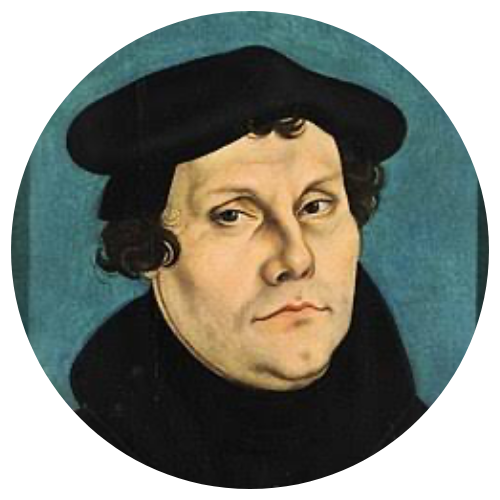
Martin Luther (1483–1546): The Man Who Rediscovered the Gospel
Written by Nathan Tan
Martin Luther is perhaps the most prominent figure of the Protestant Reformation. His name is likely the first we think of when we consider the Reformation, perhaps alongside the famous story of him nailing his Ninety-Five Theses to a church door. And for good reason: the Lord used Luther mightily to bring the truth of the gospel to light.
Martin was around twenty-one years old when he entered the Augustinian monastery, following a terrifying experience caught in a thunderstorm. Fearing that he might die, he cried out to St Anne, promising that he would become a monk if he survived. He did survive, and he kept his promise.
Yet, even as a monk, Martin struggled deeply with his standing before God. He devoted himself to prayer, confession and the study of Scripture, but he could not find the peace he longed for. When he read about the righteousness of God, he understood it primarily as the righteousness by which God judges and punishes sinners. His conscience tormented him, and he feared the judgment of a righteous, holy and terrifying God. Ultimately, Martin’s great desire was simply to know that God was not angry with him.
But God, in his mercy, would lead Martin to a radically different understanding of the gospel.
As Luther studied Paul’s letter to the Romans, particularly Romans 1:17, he began to understand that the righteousness of God revealed in the gospel was not merely the righteousness by which God condemns sinners. It was also the righteousness by which God graciously justifies sinners through faith.
In his own words:
“Here I began to understand that the righteousness of God is that by which the righteous lives by a gift of God, namely by faith.”
He went on to describe the joy of this discovery:
“Here I felt that I was altogether born again and had entered paradise itself through open gates.”
What a transformation! The God whose righteousness had once filled Luther with dread became the God whose gracious righteousness he could rejoice in. The gospel was no longer a message of condemnation for him, but the good news of God’s grace to sinners through Jesus Christ. The passage that had once troubled him became, in his words, the very gate of paradise.
From that point on, Luther became a remarkably prolific preacher, teacher and writer. He preached extensively, helped make the Scriptures accessible to ordinary people, and consistently emphasised the authority and sufficiency of God’s Word. He did not merely call others to hear the gospel; he continued to immerse himself in Scripture throughout his life. In 1545, just a year before his death, he wrote:
“Let the man who would hear God speak, read Holy Scripture.”
Luther’s life was also transformed in the ordinary, everyday setting of family life. In 1525, at the age of forty-one, he married Katharina von Bora, a former nun. Luther famously gave several reasons for marrying, including his desire to please his father and to spite the devil and the pope! Though some of his contemporaries were surprised by the decision, their marriage became an important example of family life in the emerging Reformation. Together, Martin and Katharina had six children, and they also cared for four orphaned children. Their home became a place of hospitality, learning and lively conversation, with Katharina playing a vital role in managing the household.
Speaking of Luther’s death, although it might have made for a fitting alliteration, Martin was not martyred. He died in 1546, aged sixty-two, probably following a heart attack or stroke. Yet his life remained marked by a determination to stand upon the Word of God and proclaim the gospel of Jesus Christ.
Martin Luther’s life was one in which God sovereignly worked to further his kingdom and purposes. From a frightened young monk, desperate to know God’s favour, to a Reformer who proclaimed the riches of God’s grace, Luther’s story reminds us of the transforming power of the gospel. His was a life marked by trust in God’s Word, confidence in Christ’s righteousness, and a desire to make the good news known.
So, brothers and sisters in Christ, I want to leave you with two encouragements.
First, look to Christ when your conscience troubles you. Perhaps you find yourself in the shoes of the younger Martin Luther, burdened by your sin and anxious about your standing before God. Do not look to your own goodness or efforts to make yourself right with him. Look to Christ, who has paid the price for our sins, and rest in the forgiveness and grace secured through his sacrifice. By grace, we are justified through faith in Christ alone.
As Romans 5:20–21 reminds us, where sin increased, grace abounded all the more, so that grace might reign through righteousness, leading to eternal life through Jesus Christ our Lord.
Second, follow the example of the older Martin Luther. Let us meditate on the Word of God, grow in our understanding of the gospel, and make Christ known to whoever crosses our paths. May we keep returning to the Scriptures, allowing God’s truth to shape our hearts, our lives and our witness until our time is up.
May the Lord grant us the same confidence in his Word and the same resolve to proclaim his glorious gospel.
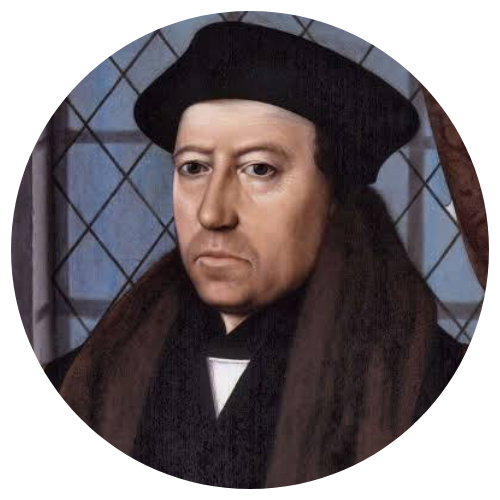
Thomas Cranmer (1489–1556): The Reformation and the English Church
Written by Gill Cox
The Protestant Reformation was a return to what the Reformers believed the Bible teaches: that sinners are justified by faith in Jesus Christ alone, not on the basis of faith combined with the merit of charitable works. This conviction would shape the life and ministry of Thomas Cranmer, one of the most influential figures in the English Reformation.
Cranmer was an English theologian who served as Archbishop of Canterbury during the reigns of Henry VIII and Edward VI, and briefly under Mary I. Although ordained as a Catholic priest, his studies at Cambridge, particularly his engagement with biblical scholarship and early Christian writings, helped shape his developing Protestant convictions.
Cranmer played a significant role in England’s break with Rome. He helped build the case for the annulment of Henry VIII’s marriage to Catherine of Aragon, a dispute that contributed to the separation of the English Church from papal authority. He also supported the principle of royal supremacy, under which the monarch was recognised as the supreme governor of the Church of England.
However, it was during the reign of Edward VI that Cranmer was able to advance the Protestant Reformation more decisively.
Reforming the Church of England
Cranmer’s greatest legacy was his work in reforming the doctrine and worship of the English Church. In 1544, he helped produce an English litany, making an important contribution to the development of English-language public worship. His most influential achievement followed in 1549, when the first Book of Common Prayer was introduced. Cranmer was its principal architect, and it established a common pattern of worship in English for churches throughout the country. He subsequently helped produce a revised edition in 1552.
These changes were more than simply a matter of translating services into the language of ordinary people. Cranmer sought to reshape the Church’s teaching and worship in accordance with his understanding of Scripture. He promoted Protestant teaching on justification by faith, revised the Church’s understanding of the Lord’s Supper, and supported changes to clerical discipline and religious practices.
Through these reforms, Cranmer helped establish the doctrinal and liturgical foundations of what would become the Reformed Church of England. His influence would continue through the Book of Common Prayer and the Thirty-Nine Articles, the historic statement of Anglican doctrine that developed from the English Reformation.
A Martyr of the Reformation
When Edward VI died in 1553, his Catholic half-sister Mary I ascended the throne and began restoring Catholic worship and papal authority in England.
Cranmer was arrested and imprisoned. His support for the attempt to place the Protestant Lady Jane Grey on the throne contributed to his political difficulties, but he was also charged with heresy because of his Protestant beliefs.
Under intense pressure from church and state authorities, Cranmer signed a series of recantations in which he appeared to renounce his Protestant convictions and return to the Catholic faith. Yet his recantations did not save him. He remained condemned to death.
On 21 March 1556, Cranmer was taken to Oxford to be executed. In a final public address, he withdrew his recantations and reaffirmed his Protestant convictions. According to contemporary accounts, he declared his rejection of the pope and resolved to place the hand that had signed his recantations into the flames first.
He was burned at the stake that day.
Cranmer’s final actions transformed his legacy. Having briefly yielded under pressure, he publicly reaffirmed the convictions for which he had suffered. For Protestants, his death became a testimony to the importance of remaining faithful to the truth of the gospel, even in the face of persecution.
Thomas Cranmer’s influence remains evident in Anglican worship and theology today. His work on the Book of Common Prayer and his contribution to the development of the Thirty-Nine Articles helped shape a lasting Protestant tradition within the Church of England.
His life reminds us that the Reformation was not merely a political struggle or a dispute over church authority. At its heart were profound questions about the gospel, the authority of Scripture, and how sinners are made right with God through Jesus Christ.
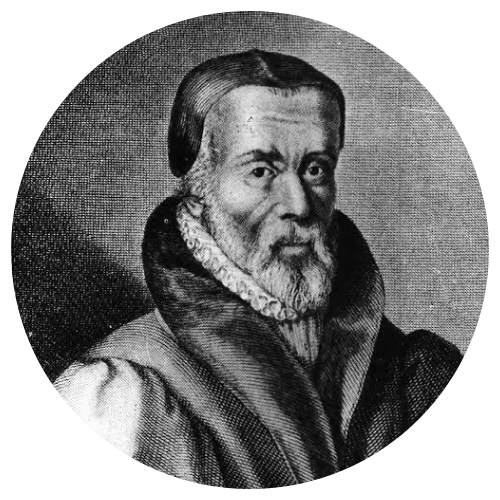
William Tyndale (c. 1494–1536): The Man Who Gave the Bible to Ordinary People
Written by Jordan Wheatcroft
William Tyndale stands as one of the most significant figures in the history of the English Bible. Born around 1494 and executed for heresy in 1536, he devoted his life to translating the Scriptures into the language of ordinary English people. His work laid the foundations for later English Bible translations, and his influence can still be heard in the language of English Bibles today.
Tyndale lived during a period of enormous change in Europe. The invention of the printing press had transformed the spread of knowledge, Renaissance scholars were returning to the original biblical languages, and the Protestant Reformation was challenging long-established religious authority. The publication of Erasmus’s Greek New Testament in 1516 and the emergence of Martin Luther’s Reformation helped shape the religious world in which Tyndale pursued his work.
Educated at Oxford and Cambridge, Tyndale possessed exceptional linguistic ability. One account of his life describes him as so skilled in eight languages—Hebrew, Greek, Latin, Italian, Spanish, English, French and German—that whichever language he spoke, people might have mistaken it for his native tongue.
This remarkable ability equipped him for the task for which he is remembered. Rather than relying primarily on the Latin Vulgate, Tyndale worked directly from the Greek New Testament and the Hebrew Old Testament, seeking to translate the Scriptures into clear, accurate English that ordinary people could understand.
A Bible for ordinary people
Tyndale became increasingly convinced that the Scriptures should not be kept beyond the reach of ordinary Christians. He believed that people needed to hear and understand God’s Word for themselves, rather than depend entirely upon the explanations of religious authorities.
According to a well-known account of his life, Tyndale once heard a clergyman argue that it was better to be without God’s laws than without the Pope’s. Tyndale responded with a bold declaration:
“I defy the Pope and all his laws; and if God spare my life, ere many years, I will cause a farm boy to know more of the Scripture than he does.”
Whether we are considering a farmer, a tradesman or a labourer, Tyndale wanted people from every walk of life to understand the Word of God. His ambition was not simply to produce an impressive scholarly work, but to make the truth of Scripture accessible to those who had previously struggled to read it in their own language.
Tyndale later explained his conviction in these words:
“I perceived how, that it was impossible to establish the lay people in any truth, except the Scripture were plainly laid before their eyes in their mother tongue.”
For Tyndale, translating the Bible was not merely an academic exercise. It was an act of Christian service. He wanted people to encounter God’s Word, understand the gospel of Jesus Christ and grow in their knowledge of the truth.
The cost of translating the Bible
When church authorities in England refused to support his translation work, Tyndale left the country and continued his labours in continental Europe. There, despite the danger and uncertainty of life in exile, he pressed on with his work.
In 1526, the first printed edition of his English New Testament was produced. Copies were smuggled into England, sometimes concealed among shipments of cloth and other merchandise. Church authorities worked to seize and destroy them, fearing the influence of a translation that placed the Scriptures directly into the hands of ordinary people.
The Bishop of London, Cuthbert Tunstall, publicly opposed Tyndale’s New Testament and organised the purchase and burning of copies. Yet these efforts produced an unexpected result. A merchant named Augustine Packington arranged for Tunstall to purchase large quantities of the books, with the proceeds helping Tyndale pay his debts and finance further printing. The very money intended to suppress the translation helped fund its continued production.
Tyndale was more than a Bible translator. He was also a prolific writer who defended the authority of Scripture and explained the central teachings of the Reformation. His works included The Obedience of a Christian Man, The Parable of the Wicked Mammon and The Practice of Prelates.
At the heart of his teaching was the distinction between God’s law, which exposes our sin and condemns us, and the gospel, which announces the salvation God has provided through Jesus Christ. Tyndale expressed this distinction through a memorable illustration:
“The Law and the Gospel are two keys. The Law is the key that shutteth up all men under condemnation, and the Gospel is the key which opens the door and lets them out.”
The law reveals our guilt and our need for a Saviour. The gospel proclaims the good news that forgiveness and righteousness are found in Jesus Christ. This was the message Tyndale longed for ordinary people to understand through reading the Scriptures in their own language.
“Lord, open the King of England’s eyes”
After years of labour, sacrifice and exile, Tyndale was betrayed by a man named Henry Phillips and arrested near Antwerp in 1535. He was imprisoned at Vilvoorde Castle, near Brussels, and endured a lengthy trial before being convicted of heresy.
On 6 October 1536, Tyndale was executed. He was strangled and then burned at the stake.
His final words are traditionally recorded as a prayer:
“Lord, open the King of England’s eyes.”
The prayer is a fitting summary of Tyndale’s life’s work. He longed for the English people, including their king, to have access to God’s Word and to understand the gospel it proclaimed.
His prayer would soon find a remarkable echo in events in England. In 1537, an English Bible known as the Matthew Bible, which incorporated much of Tyndale’s translation, received royal authorisation. In 1539, the Great Bible was authorised for use in English churches. Although Tyndale did not live to see these developments, his work had helped lay the foundations for them.
Tyndale’s influence continued through subsequent English translations, including the King James Version of 1611, whose translators drew extensively upon his work.
A legacy written into the English Bible
William Tyndale was a gifted scholar, a courageous reformer and a faithful servant of Christ. He believed that God’s Word belonged in the hands of ordinary people, and he was willing to endure exile, imprisonment and death rather than abandon that conviction.
His story reminds us not to take our access to the Bible for granted. Many of us can read the Scriptures whenever we wish, in our own language and without fear of persecution. Yet that freedom came at a cost, and men like Tyndale laboured and suffered so that others might know the Word of God.
Nearly five centuries later, his work remains part of the legacy enjoyed by English-speaking Christians around the world.
May we treasure the Scriptures he gave so much to translate, seek to understand them faithfully, and share their life-giving message with others. For the Bible does not merely give us words to read; it directs us to Jesus Christ, the Saviour whom Tyndale longed for all people to know.
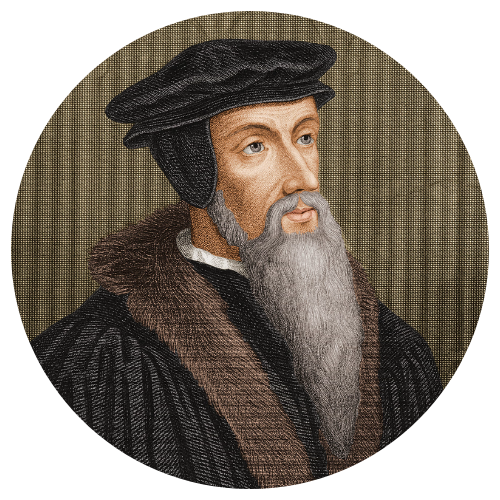
John Calvin (1509–1564): A Life Transformed for the Glory of God
Written by Earl and Elijah Gellie
John Calvin was born in 1509 in Noyon, a town in northern France. As a young boy, his father intended him to pursue a career in the Church. However, his father later redirected him towards the study of law, believing it offered better prospects for financial security.
Calvin studied in Paris before continuing his legal education at the universities of Orléans and Bourges. He became a highly accomplished scholar, combining his legal studies with an interest in classical literature and the humanities.
In 1532, at around twenty-two years of age, Calvin published his first book: a commentary on De Clementia, a work by the Roman philosopher Seneca. He appeared to be on track for a successful academic career. Yet God had other plans.
Proverbs 19:21 reminds us:
“Many are the plans in a person’s heart, but it is the LORD’s purpose that prevails.”
Calvin had pursued the path laid out for him, but his life would soon take a very different direction.
A sudden conversion
Around 1533, Calvin experienced what he later described as a sudden conversion. The precise circumstances of his conversion remain uncertain, but he clearly understood it as the work of God, who had brought him to a new understanding of the truth.
In the preface to his commentary on the Psalms, Calvin reflected on this turning point:
“God by a sudden conversion subdued and brought my mind to a teachable frame.”
He went on to explain that, having received a taste of true godliness, he was filled with an intense desire to grow in his understanding of it.
Calvin’s conversion transformed the direction of his life. Rather than pursuing academic success for its own sake, he increasingly devoted his gifts to understanding the Scriptures and making their truths known to others.
In 1536, he published the first edition of what would become his most famous work, The Institutes of the Christian Religion. This book presented a systematic explanation of the Christian faith, addressing subjects such as God, humanity, Christ, the Holy Spirit, salvation and the Church. Calvin would substantially expand and revise it throughout his life.
Two things are worth highlighting about Calvin’s work.
First, his academic background served him well. His training in law, languages and classical literature helped him read carefully, construct arguments and explain complex ideas with precision. These skills became invaluable in his interpretation of Scripture.
Second, Calvin understood that intellectual ability alone was not enough. He believed that we depend upon the Holy Spirit to understand and receive the truths God has revealed.
As Paul writes in 1 Corinthians 2:12:
“Now we have received not the spirit of the world, but the Spirit who is from God, that we might understand the things freely given us by God.”
Calvin’s life reminds us that rigorous study and dependence upon God’s Spirit belong together. We should work diligently to understand God’s Word while recognising that our understanding is itself a gift of his grace.
Geneva: A pastor and teacher
As Protestant convictions spread through France, Calvin eventually left his homeland amid growing hostility towards evangelical believers. After spending time in Basel and elsewhere, he travelled towards Strasbourg. However, circumstances led him to Geneva in 1536, where the reformer William Farel persuaded him to remain and assist with the work of reform.
Calvin’s relationship with Geneva was not always straightforward. In 1538, he and Farel were expelled following disputes with the city’s authorities. Calvin subsequently served as a pastor to French-speaking refugees in Strasbourg. In 1541, he returned to Geneva, where he would spend the remainder of his life.
There, Calvin became a pastor, preacher, teacher and shepherd of God’s people. He was deeply committed to the careful exposition of Scripture, preaching through biblical books rather than simply selecting isolated passages to suit his own interests.
His preaching schedule was demanding. He regularly preached several times each week, alongside his extensive work in writing commentaries, teaching theology and providing pastoral care. Over his ministry, Calvin delivered thousands of sermons.
His commitment to preaching reflected his conviction that the Church must continually be shaped by the Word of God. Calvin wanted Christians not merely to hear what a preacher thought, but to understand what God had spoken in Scripture.
In 1559, Calvin helped establish the Geneva Academy, an institution designed to educate students in theology and other disciplines. It became an important centre for the training of Protestant ministers, many of whom carried Reformed teaching into other parts of Europe. Through this work, Geneva became a significant centre of the international Reformation.
Calvin’s influence was therefore felt far beyond the city in which he ministered. His writings, sermons and students helped shape Protestant churches across Europe and beyond.
Reforming the Church for the glory of God
Calvin’s goal was not simply to establish a new theological school or gain a reputation as a great scholar. He wanted the Church to be reformed according to the teaching of Scripture, so that God would be worshipped rightly and the gospel of Jesus Christ would be clearly proclaimed.
He believed that the Church needed continual correction wherever its teaching and practices departed from God’s Word. This conviction shaped his preaching, his writing and his pastoral ministry.
Calvin’s life was marked by considerable hardship, persistent illness and an extraordinary workload. Yet he continued to teach, preach and write, convinced that the Church needed faithful ministers who would explain the Scriptures carefully and apply them to the lives of God’s people.
In one of his sermons on Ephesians, Calvin expressed the encouragement Christians can find in God’s provision for them:
“Though we may feel weak, we should not lose our heart but instead be courageous and pray to God for strength. Furthermore, you see why the apostle Paul speaks of spiritual blessings to remind us that while the devil may lay traps to lead us astray God will provide everything necessary to counter them. Why? Because he has such an abundance of blessings that easily frustrate and destroy everything that stands against our salvation. All glory be to God.”
These words capture a fitting theme for Calvin’s life and ministry: our confidence does not rest in our own strength, but in the abundant grace and provision of God.
John Calvin died in Geneva on 27 May 1564. His legacy lives on through his writings, his biblical commentaries, his influence on Reformed theology and the churches shaped by his teaching.
His life challenges us to pursue a deep understanding of Scripture, to depend upon the Holy Spirit, and to labour faithfully for the health and faithfulness of Christ’s Church.
Above all, Calvin’s example reminds us that our gifts and abilities are to be placed at the service of God, so that his Word may be understood, his Church built up, and his glory made known.
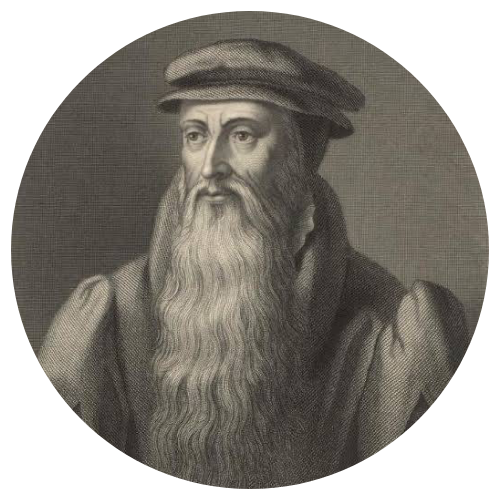
John Knox (c. 1514–1572): The Reformation of Scotland
Written by Fiona Mitchell
By the early sixteenth century, Scotland was officially Roman Catholic, but many reformers believed that the Church had become deeply compromised. Church offices were entangled with political power, some religious institutions possessed considerable wealth, and many ordinary people had limited access to Scripture in their own language.
From the 1520s onwards, Lutheran and later Reformed ideas began to spread through Scotland, carried by merchants, students and courageous preachers. Among these early Scottish reformers were Patrick Hamilton and George Wishart, both of whom were executed for their Protestant convictions. Their deaths helped intensify calls for reform and exposed the growing conflict over the authority of Scripture and the power of the Church.
It was into this turbulent world that John Knox emerged as one of the most influential figures in the Scottish Reformation.
John Knox: From galley slave to reformer
John Knox was born around 1514 in Haddington, Scotland. He was ordained as a Catholic priest in 1536 and subsequently worked as a notary. His journey towards becoming a leading Protestant reformer was shaped particularly by his encounter with George Wishart, whose preaching helped bring him towards the Reformed faith.
In March 1546, Wishart was burned at the stake for heresy on the orders of Cardinal David Beaton, Archbishop of St Andrews. His execution profoundly affected Knox. Later that year, Beaton himself was assassinated by a group of Protestant conspirators, who subsequently occupied St Andrews Castle. Knox joined the Protestant community there and began his public preaching ministry.
In July 1547, French forces captured the castle. Knox was taken prisoner and spent approximately nineteen months as a galley slave aboard a French ship. The experience severely damaged his health, but it did not extinguish his commitment to the gospel.
Released in 1549, Knox travelled to England, where he found a new platform for his reforming convictions. He was licensed to preach during the reign of the Protestant King Edward VI, ministered in Berwick and Newcastle, and eventually became a royal chaplain. He also contributed to discussions about reforming the worship of the Church of England.
However, when Edward VI died in 1553 and the Catholic Mary I came to the English throne, Knox was forced to flee. His journey eventually took him to Geneva, where he encountered the influence of John Calvin and became increasingly convinced of the importance of biblical preaching, Reformed theology and disciplined church life.
Knox described Geneva as “the most perfect school of Christ that ever was in the earth since the days of the Apostles.”For him, Geneva offered a compelling example of a community seeking to order its church life according to the Word of God.
During these years, Knox’s understanding of the relationship between Scripture, the Church and political authority also developed. He believed that no ruler stood above God’s Word and that civil authorities, like everyone else, were accountable to God.
1559–1560: The Reformation of Scotland
In May 1559, Knox returned to Scotland amid growing opposition to the Catholic regency of Mary of Guise, who governed on behalf of her daughter, Mary, Queen of Scots. Protestant nobles known as the Lords of the Congregation had pledged to support the advancement of Reformed teaching and were increasingly determined to change the religious direction of the country.
Knox’s preaching became a powerful catalyst for the Scottish Reformation. His sermons challenged what he regarded as idolatry and unbiblical worship, encouraging many to reject established religious practices. In several places, crowds destroyed religious images, altars and monastic buildings.
The Scottish Reformation was not, however, a peaceful or uncomplicated movement. Religious conviction became intertwined with political conflict, armed resistance and the destruction of religious and cultural property. The desire to reform the Church according to Scripture was sometimes accompanied by actions that caused significant loss and suffering.
Political events soon accelerated the movement. English forces supported the Protestant lords, while French troops continued to support Mary of Guise. Following her death in June 1560, the Treaty of Edinburgh helped bring the military conflict to an end and weakened French influence in Scotland.
In August 1560, the Scottish Parliament repudiated papal authority, prohibited the celebration of the Mass, and adopted the Scots Confession of Faith. The Confession had been prepared by six Protestant ministers, with Knox generally regarded as its principal author.
These developments marked a decisive turning point. Scotland had officially embraced Protestant reform, although the subsequent establishment and development of the Reformed Church would continue over many years.
Knox’s contribution extended beyond preaching. He helped shape the First Book of Discipline, which set out a vision for the organisation and ministry of the reformed Church. It addressed not only doctrine and worship but also education, the provision of ministers, and care for the poor.
The vision was ambitious: a reformed Church should teach God’s Word faithfully, educate the next generation and provide for those in need. Yet the plan faced considerable resistance, particularly when it came to distributing the wealth and property necessary to fund these reforms. The unwillingness of powerful interests to support the proposed programme revealed the tension between professed religious conviction and the practical demands of Christian responsibility.
How did John Knox die?
John Knox died in Edinburgh on 24 November 1572, after years of demanding ministry and declining health. His time as a galley slave had left lasting effects, and his final years were marked by physical weakness. The precise medical cause of his death is uncertain, and claims that he was poisoned should not be repeated as established fact.
His final days reflected the priorities that had shaped his ministry. As his strength failed, he continued to find comfort in Scripture and prayer. According to an account recorded by his associate Richard Bannatyne, Knox asked his wife to read John 17, the prayer of Jesus for his people, describing it as the passage where he had first cast his anchor.
What a fitting image for a man whose life had been marked by political turmoil, religious controversy and personal suffering. At the end, Knox’s confidence rested not in his achievements or his reputation as a reformer, but in Jesus Christ.
At his burial, the regent, the Earl of Morton, reportedly declared:
“Here lies one who never feared the face of man.”
Whether we agree with every aspect of Knox’s methods or his political convictions, his influence on the Scottish Reformation and the development of Presbyterianism is undeniable.
How did God use John Knox to reform his beloved Church?
John Knox’s life raises important questions about how God reforms his Church and what faithfulness looks like in our own time.
1. The triune God reforms whole societies, not just individual hearts
The Scottish Reformation was concerned with more than private religious belief. The reformers sought to reshape the worship, teaching and organisation of the Church, while also addressing education, poverty and public life.
Their vision was grounded in the work of the triune God: the Father who rules over all things, the Son who redeems his people, and the Holy Spirit who gives life to the Church and equips it for faithful service.
This reminds us that the gospel speaks to every part of life. Following Jesus affects not only our private devotion but also how we worship, educate our children, use our resources and care for our neighbours.
2. Scripture above all: a gift and a warning
Knox’s insistence that Scripture must govern the Church challenged religious authorities and helped establish a lasting Protestant commitment to the authority of God’s Word.
Yet his legacy also invites careful reflection. A sincere desire to defend biblical truth does not automatically make every action or attitude right. Zeal for truth must be accompanied by humility, patience and love.
As Christians, we must hold firmly to Scripture while remembering that the fruit of the Spirit includes gentleness and self-control. We are called not merely to defend the truth, but to embody it in the way we treat others.
3. Grace must touch money and power, or our profession is incomplete
The First Book of Discipline envisioned a Church committed to education, the support of ministers and the relief of poverty. Yet these plans struggled to gain the financial backing they required.
This reveals an enduring temptation: it is possible to affirm the gospel with our words while resisting the practical implications of grace for our resources and responsibilities.
If we proclaim God’s generosity but hoard what we have, or speak of justice while protecting our own interests, our lives contradict the message we profess. The grace we receive from Christ should shape how we use our money, exercise authority and care for those in need.
4. Unity in the Trinity: pursuing purity without losing love
The Scottish reformers sought a Church united in truth and faithful to Scripture. Yet the history of the Reformation also reminds us that the pursuit of religious purity can become entangled with coercion, hostility and violence.
The triune God calls his people to a unity grounded in truth and expressed through love. We should not abandon our convictions for the sake of superficial peace, but neither should we imagine that harshness or hostility is proof of faithfulness.
Our task is to hold together truth and love, seeking the purity of Christ’s Church while treating others with the patience and grace that we ourselves have received.
A final word from John Knox
John Knox’s life reminds us that the Church must continually return to God’s Word, depend upon his grace and seek his glory in every area of life.
One of his most enduring and well-attested statements offers a fitting conclusion:
“Prayer is ane earnest and familiar talking with God, to whome we declair oure misereis, whois support and help we implore and desyre in our adversiteis, and whome we laude and prais for oure benefittis receaved.”
In modern English, Knox describes prayer as earnest and familiar conversation with God, in which we confess our troubles, seek his help and praise him for his goodness.
May we share Knox’s conviction that God’s Word must govern the life of the Church, his concern for the faithful reform of Christ’s people, and, above all, his dependence upon the grace of God through Jesus Christ.
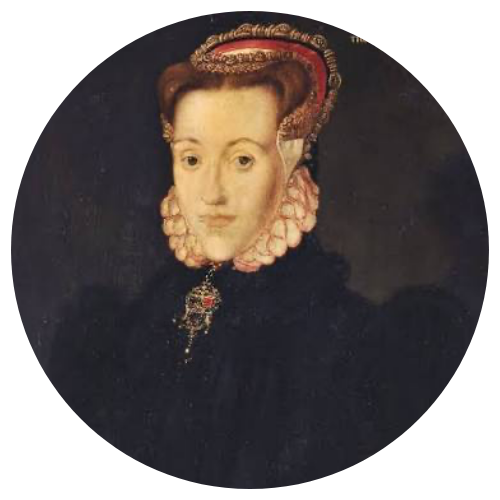
Lady Anne Askew (1521–1546): A Faith That Would Not Be Silenced
Written by Nicole Thompson
Anne Askew was a well-educated English noblewoman, the daughter of a knight, who lived during the early years of the Protestant Reformation.
When her older sister tragically died, Anne’s father arranged for her to marry her sister’s fiancé, a wealthy landowner named Thomas Kyme. Anne was only fifteen years old.
This was a time of enormous upheaval. The Church in England had broken away from Rome, and printed English translations of the Bible were becoming increasingly available. More ordinary people could now read the Word of God in their own language.
Anne immersed herself in the Scriptures. She embraced Protestant convictions, including the belief that believers could approach God directly through Christ rather than needing a priest to confess their sins, and that ordinary Christians should have access to God’s Word.
Her husband, however, remained a loyal Catholic, and they lived in a region particularly hostile to Protestant beliefs.
As you can imagine, the relationship between Anne and her husband became increasingly strained.
Eventually, the King imposed restrictions on who could read the Bible. The law severely limited public Bible reading among women and those of lower social standing. But Anne refused to abandon her convictions. She continued to read her Bible, both privately and publicly, and refused to participate in Catholic confession. Enraged, her husband threatened to banish her if she did not stop.
Anne stood her ground. She was violently driven from her own home, forced to leave her two young children behind.
She travelled to London, seeking a divorce.
There, she connected with other like-minded women, including the Duchess of Suffolk and Queen Catherine Parr, Henry VIII’s sixth and final wife. Anne also attended Bible studies in the Queen’s private chambers.
But Anne was being watched. Powerful officials arrested her, hoping to use her to gather information that could implicate the Queen. She was interrogated about her “radical beliefs”, particularly concerning the Lord’s Supper, Christ’s presence in the sacrament, the sufficiency of Christ’s death for sin, and other matters of doctrine.
Standing before bishops, judges and the Lord Mayor of London, this young woman faced her interrogators with remarkable boldness. Drawing on the Scriptures she had memorised, she challenged their arguments and exposed what she believed to be their errors.
When she refused to recant, Anne was sent to the Tower of London, where she was subjected to torture on the rack. Torturing a woman of noble birth was considered unlawful, and the official executioner reportedly refused to participate. Nevertheless, Thomas Wriothesley, the Lord Chancellor of England, personally took hold of the rack’s wheels and helped stretch her body.
Anne endured the torture without abandoning her convictions. She recanted nothing and sought to protect others who shared her faith.
Several weeks later, at just twenty-five years of age, Anne was condemned to be burned at the stake alongside three other Protestant men. Her body had been so badly broken by the torture that she had to be carried to the stake and secured to a chair.
In her final moments, surrounded by a large crowd, she was reportedly offered a royal pardon if she would abandon her beliefs. Her response was resolute:
“I came not hither to deny my Lord and Master.”
What a remarkable story.
As I reflect on Anne’s life, two things in particular deeply challenge me.
1. Her love for God’s Word
Anne treasured the Scriptures. She studied them, memorised them and shared their truths with others, even when doing so carried enormous personal risk.
We live in a very different time. We have safe, unrestricted access to God’s Word. We can read it in our own homes, study it with others and explore its truths without fear of imprisonment or death.
But do we truly treasure it?
Do we search the Scriptures, study them carefully and commit them to memory? Do we thirst to go deeper into theology and grow in our understanding of God, or are we content to lean on the faith and understanding of others? Are we willing to make sacrifices to share the gospel with those around us?
Anne’s example challenges us not to take our access to God’s Word for granted, but to treasure it, know it and make it known.
2. Her endurance
Anne possessed a faith so deeply anchored in Christ that she would not deny him—not to remain under her husband’s protection, not to appease the highest authorities in the land, and not even to escape torture and an agonising death.
The historian John Foxe wrote of Anne that she was:
“born of such stock and kindred that she might have lived in great wealth and prosperity, if she would rather have followed the world than Christ.”
Anne could have pursued a life of comfort and security. Instead, she chose to remain faithful to Christ, whatever the cost.
Her example raises searching questions for us:
-
What are we willing to give up to follow Christ?
-
Are we equipped to defend our faith with such boldness?
-
Are we prepared to endure opposition for the sake of the gospel, or do we crumble under the slightest social pressure?
How did a twenty-five-year-old woman find such extraordinary resilience?
A poem Anne wrote while imprisoned offers us a clue. Consider these lines:
Faith in the fathers old
Obtained righteousness
Which make me very bold
To fear no world’s distress.I now rejoice in heart
And Hope bid me do so
For Christ will take my part
And ease me of my woe.
On thee my care I cast.
For all their cruel spight
I set not by their haste
For thou art my delight.
(see full poem).
The Lord was her delight.
Anne’s confidence did not ultimately rest on her own strength or determination. It rested on Christ, her Saviour, whom she trusted to take her part and sustain her through suffering.
Her courage flowed from a deep and personal confidence in the One to whom she belonged. She knew that even if she lost everything in this life, she would not lose Christ.
That Christ may be exalted in us
Paul expresses a similar confidence in Philippians 1:20:
“I eagerly expect and hope that I will in no way be ashamed, but will have sufficient courage so that now as always Christ will be exalted in my body, whether by life or by death.”
Paul’s desire was that Christ would be exalted in him, whatever circumstances he faced—even if faithfulness meant death.
That was the desire reflected in Anne Askew’s life. She treasured God’s Word, stood firm in the truth and endured suffering because Christ was her delight.
May we, too, grow in our love for God’s Word and in our confidence in Christ. And may we find in him the courage to remain faithful, whatever the cost, so that Christ may be exalted in us, as he was in the life of Lady Anne Askew.